
Puerto Rico has become the Caribbean extension of the Bible Belt. Interestingly, the main importers of US-styled fundamentalist Christianity have been local politicians, not missionaries from the US. The politicians are tightening the belt quickly, shamelessly violating the separation of church and state.
For instance, earlier this year, the governor decreed a "Day of Prayer," following in the footsteps of his predecessor, who a few years ago decreed the establishment of municipal "faith-based offices." Christian faith only, of course.
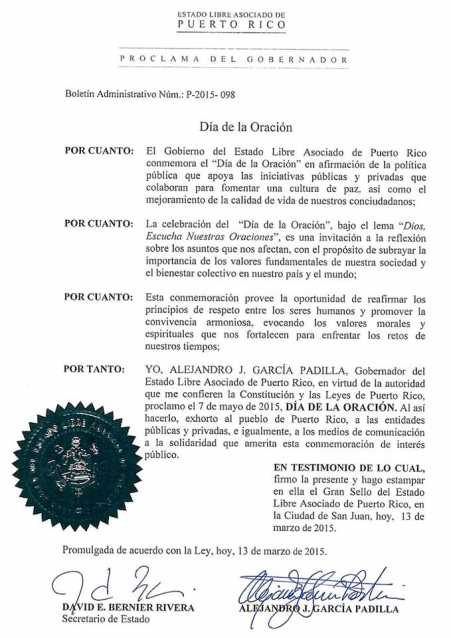
Puerto Rico's governor declares May 7 as the "Day of Prayer." Christian prayer, that is.
The same happens at the municipal level. A majority of the island's 78 mayors have imposed "Fasting and Praying" events in their municipalities. The promotional flyers for these events clearly show they're backed by the mayors, bringing one to imply they are being financed with taxpayer money. This should raise eyebrows, considering Puerto Rico's economy has been in a deep recession for almost a decade and could default on $72 billion in government debt any day now.
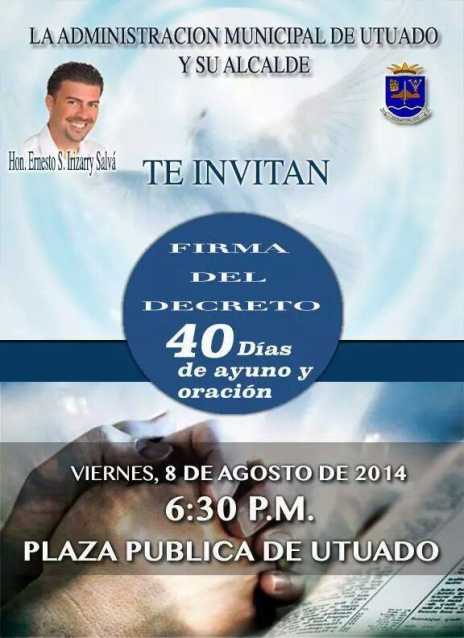
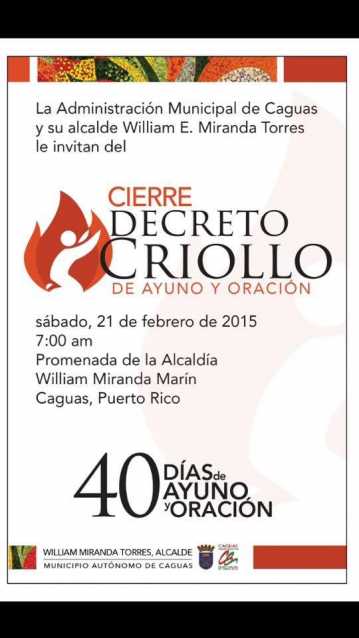
Flyers promoting two municipalities' "Fasting and Praying" events. The mayors are clearly sponsoring these events.
Even some cops have joined in the Bible thumping propaganda and have done so while on duty. Municipal police officers in two municipalities have been setting up what they call "Faith Roadblocks" with the purpose of stopping drivers to pray for them. Meanwhile, Puerto Rico is suffering from an alarming murder rate, with 680 homicides reported in 2014 and almost 400 so far this year.

In Puerto Rico, some cops set up "Faith Roadblocks" to stop drivers and pray for them.
Of course, politicians are just using religion to attract voters and, yes, most voters on the island are Jesus fearing folks, which explains why politicians and cops can get away with blurring the line between church and state with very little consequences.
Still, there is hope. In an attempt to create awareness of the importance of a secular state, a few local humanists have established the First Pastafarian Church of Puerto Rico. Pastafarianism, or the Church of the Flying Spaghetti Monster, was originally conceived in the US in 2005 by a physics major to make fun and expose the fallacies of the anti-science "intelligent design" theory being spread by fundamentalist Christians. It has since spread all over the world.
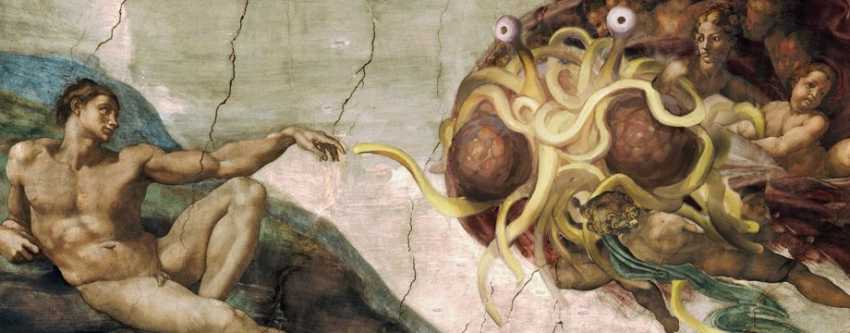
Hopefully, the Flying Spaghetti Monster will make Puerto Ricans realize how the separation of church and state is in their best interest
"Christian privilege and the violation of the separation of church and state are seen too frequently in the government," said Efrain Flores, one of the newly ordained Pastafarian ministers in Puerto Rico. "The fact that there are such things as "faith-based offices" proves that this has reached a level of complete impunity. Here in Puerto Rico, the municipality-sponsored fasting and praying events [and] the Holy Week celebrations held at the Capitol by the Speaker of the House of Representatives, warrant that we get involved to demonstrate that a secular state benefits all of society."
But becoming a Pastafarian minister in Puerto Rico was no easy feat. "We registered as celebrants online before incorporating, and that did not require any human interaction, but when we went to the Demographic Registrar's Office [to obtain a celebrant license and be allowed to officiate] the story changed," Flores said.
Normally, he noted, these licenses are given for a two-year period, but only one of the Pastafarians received a two-year license while the other two ministers' licenses were only valid for one year. "The excuse they gave us, which we believe is bogus, is that the license would not be valid for more than two years if the church was based outside of Puerto Rico," Flores said.
Flores and the other Pastafarians were also served with a fair share of attitude at the Demographic Registrar's Office. "I got there early in the morning, so I was the first client there that day. When I gave the clerk my documents, she pointed to the Pastafarian logo and said sternly 'lately, several people from this church -or whatever this is, because it's not a church- have been coming here. What is this?'," Flores remembered.
"Intimidated, I said, 'this is a church. We believe the universe was created by that Supreme Being' but the lady, silent, kept looking at me in disbelief, so I added 'there are people who believe that snakes can talk and convince a woman to eat a fruit.' I ended my argument in a casual tone simply saying 'religions are like that.' Then the lady handed me some papers and said 'fill out these documents.'"
In the end, the Pastafarian ministers got their licenses, which means they are allowed to officiate weddings. Just a few days ago they officiated their first same-sex wedding. (Puerto Rico began issuing marriage licenses to same-sex couples on July 13.) Flores said that the Pastafarians have been approached by more couples, gay and straight, interested in being married by them.
Besides officiating weddings, the Pastafarians have begun performing humanist liturgical acts. "The La Mega radio station began its July 9 programming with a prayer by one of our ministers," Flores said.
Despite the occasional heckler and the fact that not a single government official has shown support for Flores and his fellow ministers, Pastafarianism is off to a good start in Bible Belt-strapped Puerto Rico.
